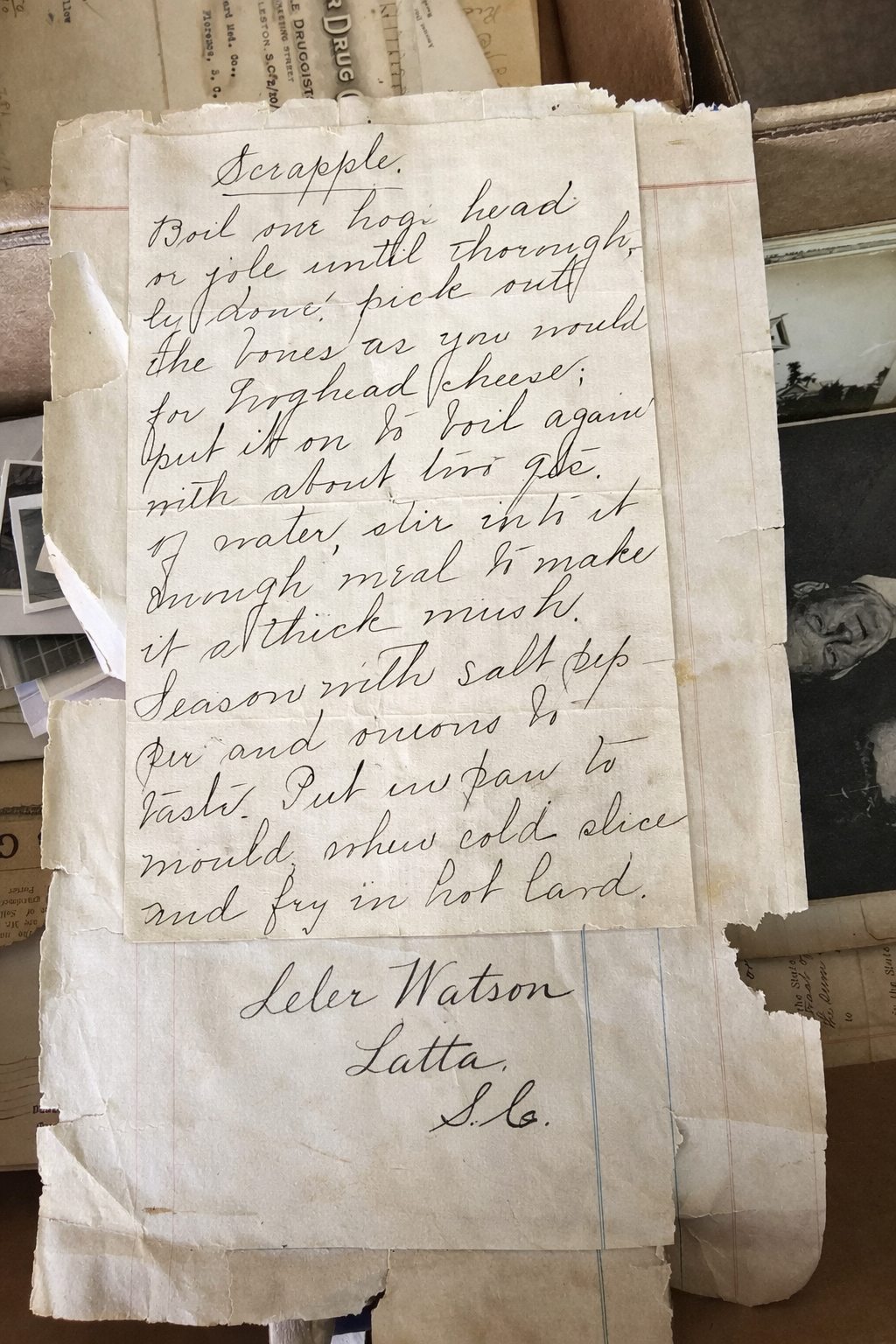
There’s something powerful about holding an old handwritten recipe in your hands. The paper is fragile, the ink faded, but the instructions are steady and confident — written by someone who knew exactly what they were doing. This particular recipe, titled “Scrapple,” was signed Leler Watson of Latta, South Carolina. What it describes is a classic Southern hog-killing staple: hog head scrapple.
Before we modernize it, here is the original recipe exactly as written, preserved to give proper credit to the Watson family line:
Original Handwritten Recipe
Scrapple
Boil one hog head or jole until thorough; remove, pick out the bones as you would for hoghead cheese; put it on to boil again with about two gals. of water, stir in meal to make it a thick mush. Season with salt, pepper and onions to taste. Put in pan to mould; when cold slice and fry in hot lard.
Leler Watson
Latta
S.C.
Scrapple vs. Head Cheese: What’s the Difference?
Head cheese and scrapple begin the same way: by boiling a hog’s head until the meat is tender and separates from the bone.
Head cheese, despite its name, contains no dairy. The cooked meat — including cheeks, tongue, and other tender pieces — is chopped, seasoned, and packed into a mold with some of the natural gelatin-rich broth. As it cools, the collagen sets and binds everything together. It is typically sliced and eaten cold or lightly fried.
Scrapple uses that same cooked meat but stretches it further by adding a grain. In the Mid-Atlantic states, particularly Pennsylvania, scrapple often contains buckwheat flour. In the South and Deep South, cornmeal was the natural choice. It was abundant, affordable, and already central to daily meals. The addition of cornmeal transforms the mixture into a thick mush that firms up when cooled, allowing it to be sliced and fried crisp in lard.
The Southern Hog-Killing Tradition
Across South Carolina, North Carolina, Georgia, Alabama, and Mississippi, hog killing was more than a chore — it was a seasonal event. Families and neighbors gathered in late fall or early winter when temperatures were cold enough to safely process meat. Large iron kettles were set over open fires. Fat was rendered into lard. Sausage was seasoned and stuffed. Hams were salted and cured. Nothing usable was discarded.
The hog’s head was especially valuable. It contains flavorful meat and a high amount of collagen, which thickens broth naturally. That gelatin is what allows head cheese to set. When cornmeal is added for scrapple, it extends the meat, making the yield larger and feeding more people from the same animal.
In much of the Deep South, scrapple was tied closely to hog-killing time rather than being an everyday breakfast item as it became in parts of the Mid-Atlantic. It would be poured into pans, allowed to set in a cool room or smokehouse, and then sliced and fried as needed. The outside would crisp while the inside stayed tender and savory.
Seasonings varied from household to household. The Watson recipe calls simply for salt, black pepper, and onions. That simplicity is consistent with traditional Southern practice. Some families added sage, especially if they favored sausage-style flavor. Others added red pepper for heat. But the foundation remained the same: meat, broth, cornmeal, and seasoning to taste.
A Taste of Latta, South Carolina
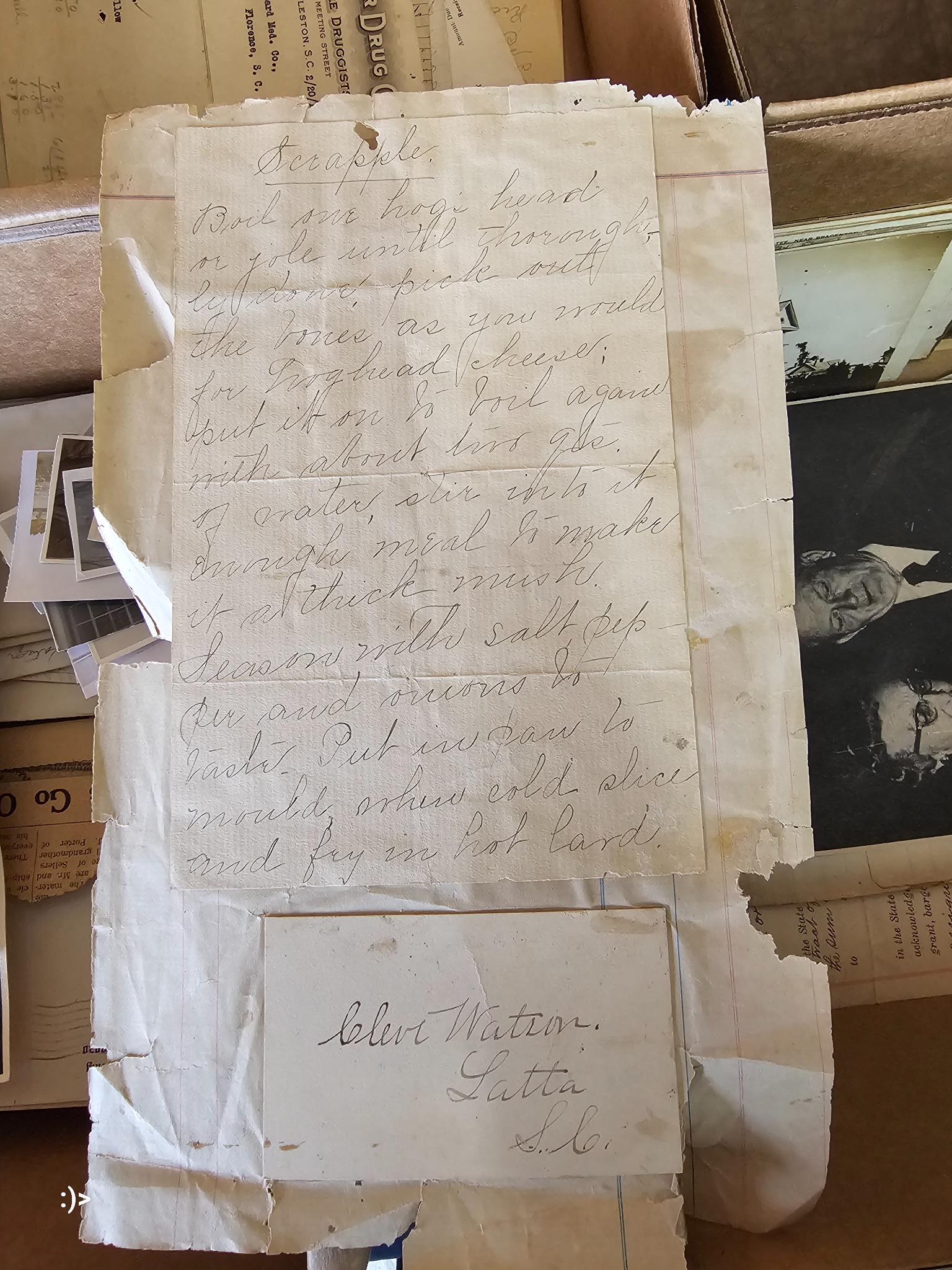
Latta sits in Dillon County in the northeastern part of South Carolina, a region long rooted in agriculture. Recipes like this reflect a time when many families either raised hogs themselves or were directly connected to someone who did. This was not novelty cooking — it was practical, necessary, and deeply traditional.
The handwritten instructions are direct and confident. There are no measurements for the cornmeal because an experienced cook knew what “a thick mush” looked like. There is no specific boiling time because tenderness was judged by feel. It was cooking by knowledge passed down, not by cookbook precision.
Modernized Version of the Watson Family Scrapple
Ingredients:
1 cleaned hog’s head or hog jowl
About 2 gallons strained cooking broth (or water if needed)
Cornmeal, enough to make a thick, spoon-standing mush
Salt to taste
Freshly ground black pepper to taste
Finely chopped onion to taste
Lard for frying
Method:
- Thoroughly clean the hog’s head or jowl.
- Place in a large pot and cover with water. Simmer gently until very tender and the meat easily separates from the bones.
- Remove from the pot and allow to cool slightly. Pick all meat from the bones, discarding bone and excess cartilage.
- Strain and reserve the cooking broth. Return the picked meat to the pot with about 2 gallons of broth (add water if necessary).
- Bring to a steady boil.
- Slowly stir in cornmeal while stirring constantly to prevent lumps. Continue adding until the mixture becomes thick and heavy.
- Season with salt, black pepper, and chopped onion to taste.
- Cook several minutes longer, stirring, until fully thickened and well blended.
- Pour into loaf pans or shallow pans to mold.
- Cool completely until firm.
- Slice and fry in hot lard until browned and crisp on both sides.
Why Recipes Like This Matter
Scrapple and head cheese are not curiosities — they are evidence of Southern foodways built on thrift, skill, and respect for the animal. They belong to the same tradition that gave us cracklins, chitlins, liver pudding, and red-eye gravy.
When you fry a slice of true hog head scrapple in a cast iron skillet, you are tasting something that sustained families for generations — including the Watson family of Latta, South Carolina.
Preserving recipes like this is not just about cooking. It is about preserving history.