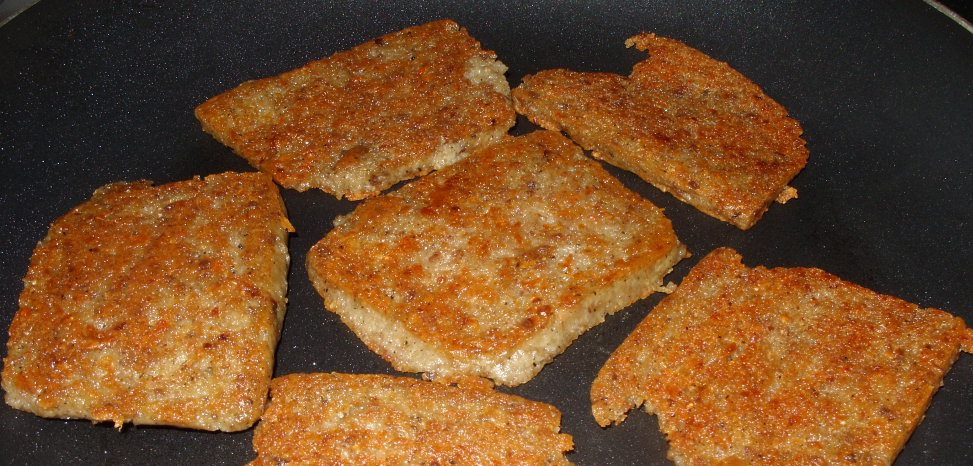
If you start in South Carolina and follow the scent of hog-killing weather, cast-iron wash pots, and breakfast skillets, you find that scrapple is not just one thing. It is a whole American family of thrift-born pork traditions: some bound with cornmeal, some with oats, some tucked into sausage casings, some pressed into loaves, some fried crisp, and some eaten cold and trembling with natural gelatin. The names change. The binders change. The texture changes. But the old idea stays wonderfully the same: use the whole hog, waste nothing, and turn humble parts into something people crave. (Southeastern Dispatch)
South Carolina is a beautiful place to begin because the state does not merely preserve one version of this tradition. It preserves several. One close cousin to scrapple is liver pudding, an old South Carolina breakfast food that historically appeared in two main styles, one bound with cornmeal and another with rice. According to the South Carolina food history excerpt from Taste the State, it was traditionally made from hog liver and other lesser-used parts, cooked long, chopped fine, seasoned, and then either stuffed into casings or poured into molds to cool into bricks. In other words, South Carolina has long had its own loaf-and-slice tradition, even if the state did not always call it scrapple. (Southeastern Dispatch)
South Carolina also developed its own related branch in hash. Hash is not sliceable like scrapple, but it comes from the same old no-waste logic. South Carolina ETV’s Digital Traditions project describes hash as unique to South Carolina, rooted in Carolina rice kitchens where African American cooks transformed hogs’ head, liver, and other parts into a rich “meat gravy” served over rice. So in South Carolina, the family tree splits early: one line becomes loaf-like liver pudding, while another becomes kettle-cooked hash. Both come from the same practical genius of making the most of the hog. (Knowitall)
That makes South Carolina a little different from the places farther north. In the Palmetto State, the question is not simply “Do you eat scrapple?” It is more likely, “Which branch of the old hog tradition do you mean?” In one community that answer may be liver pudding. In another it may be liver hash. In old butcher stalls and home kitchens, both lived side by side with the same wintertime spirit of thrift, seasoning, and comfort. (Southeastern Dispatch)
Step next door into North Carolina and the family resemblance gets even clearer. There, the most famous relative is livermush. WFAE describes western North Carolina as “the Land of Livermush,” tracing its roots to German settlers who moved down the Great Wagon Road from Pennsylvania. In western North Carolina, livermush became the beloved local form, typically made with pork parts, liver, cornmeal, and seasonings, then chilled, sliced, and fried. East of the Yadkin River, that same article notes, liver pudding is the more common name and the version there is made without cornmeal. So even within one state, naming and texture shift by region. (WFAE)
North Carolina preserves this tradition so strongly that it turned it into public celebration. NCpedia documents the state’s livermush festivals, and NCpedia’s entry on Neese’s shows how commercial makers carried these foods forward, selling liver pudding and also livermush, scrapple, and souse. That little detail says a lot: even one company recognized that these foods are cousins, not copies, and that Southern eaters still know the difference. (NCPedia)
Virginia and the Shenandoah Valley sit along the migration path that helps explain how these dishes traveled. The Great Wagon Road connected Pennsylvania German settlement to the Shenandoah Valley and on into the upland South, and WFAE explicitly ties North Carolina’s livermush story to those southbound settlers. In this corridor you also hear older names like pon hoss or pon haus, terms long associated with Pennsylvania Dutch scrapple and still remembered in Appalachian and valley food culture. The exact spelling can change from kitchen to kitchen, which is part of the charm; the dish itself remains the recognizable idea of cooked pork scraps and grain, set up, sliced, and fried. (WFAE)
By the time you reach Pennsylvania, you are standing in scrapple’s most famous homeland. The Encyclopedia of Greater Philadelphia describes scrapple as a loaf of cooked pig parts thickened with cornmeal or buckwheat, usually seasoned with sage and pepper, then cooled, sliced, and fried. This is the classic Mid-Atlantic form that many Americans picture first when they hear the word scrapple. It is strongly tied to Pennsylvania Dutch foodways and to the practical old-world habit of turning butchering leftovers into breakfast. (Encyclopedia of Greater Philadelphia)
But Pennsylvania did not keep it to itself. Delaware embraced it so thoroughly that the Delaware Division of Historical and Cultural Affairs highlights scrapple as part of southern Delaware’s historic cuisine, noting that German settlers developed it there from local ingredients. The state’s long-running Apple Scrapple Festival is another clue that this is not just a home dish; it is regional identity on a plate. (Delaware Historical Affairs)
Maryland and New Jersey belong to this Mid-Atlantic scrapple belt too. Even when individual recipes vary, the broad pattern holds: pork trimmings, a grain binder such as cornmeal or buckwheat, assertive seasoning, loaf form, and a final destiny in a hot skillet. Food historians often describe this entire corridor as scrapple country, stretching beyond Pennsylvania into Delaware, Maryland, South Jersey, and nearby regions where breakfast counters still know exactly how thick to slice it. (Encyclopedia of Greater Philadelphia)
Then the trail bends west into Ohio, northern Kentucky, and southeastern Indiana, and the grain changes. Here the best-known cousin is goetta, especially around Cincinnati. Visit Cincy describes goetta as a local specialty of the Cincinnati and Northern Kentucky region, typically made with ground meat and steel-cut oats, with roots in nineteenth-century German settlement and a link to gruetzwurst or götte, a coarse-grain sausage tradition. This is the oat-heavy branch of the family, and it is probably the version most responsible for the kind of “scrapple with oats” memory people have in Ohio. (Visit Cincinnati)
Goetta shows exactly how these foods evolve without losing their soul. The binder is not cornmeal but oats. Beef often joins pork. The seasoning profile leans in its own direction. Yet the purpose is familiar: stretch meat with grain, form it, slice it, fry it, and feed people well. That is why goetta feels like kin to scrapple even when a Cincinnatian will rightly tell you it is its own proud thing. (Visit Cincinnati)
Southern Indiana keeps another old name alive: pon haus. Modern regional programming from Evansville has highlighted pon haus as a Southern Indiana food tradition, and the name itself points back to the Pennsylvania Dutch scrapple family. In practical terms, pon haus is best understood not as a totally separate species, but as one of the older names still surviving in places where German-American settlement spread the technique west and south. (Willard Public Library)
And then there is the other branch entirely: head cheese, often called souse in parts of the South. This one is related in spirit, but different in texture. Instead of using grain to bind chopped meat into a fryable loaf, head cheese relies on natural gelatin from boiled pig parts, often with pigs’ feet, to set into a sliceable terrine. Slow Food’s Ark of Taste describes southern Louisiana hog’s head cheese, also known as souse, as a butcher-shop staple made from boiled pork scraps and pigs’ feet, sometimes sharpened with vinegar and eaten on crackers, in sandwiches, or as an appetizer. Same old no-waste wisdom, very different mouthfeel. (Fondazione Slow Food)
That distinction matters because people often blur all these foods together. Scrapple, livermush, liver pudding, goetta, pon haus, head cheese, and souse are not identical. Scrapple and its grain-bound relatives are usually meant to be browned in a skillet, where they get that irresistible crust and soft center. Head cheese and souse are usually chilled and sliced cold or cool, with a firmer, gelatin-set bite. One family is more mush-to-loaf. The other is more broth-to-terrine. Both come from the same older ethic of skilled thrift. (Encyclopedia of Greater Philadelphia)
So what does the map of America look like if you follow “anything like scrapple”? In South Carolina you find liver pudding and hash. In North Carolina you find livermush in the west and liver pudding farther east. In Virginia and Appalachia you hear pon hoss and pon haus. In Pennsylvania, Delaware, Maryland, and South Jersey you find classic scrapple. In Cincinnati, northern Kentucky, and nearby Indiana you find goetta, proudly oat-bound and regionally adored. In Louisiana and much of the Deep South, the family shifts toward souse and hog’s head cheese, where gelatin replaces grain but the hog-to-table philosophy remains the same. (Southeastern Dispatch)
What I love most about this whole American patchwork is that it tells a story bigger than breakfast. These foods remember migration routes, butcher stalls, smokehouses, German settlement, African American kitchen knowledge, rice country, mill towns, mountain communities, and river cities once rich with porkpacking. They are delicious archives. A slice of scrapple or livermush is not just a humble breakfast meat. It is a record of how people survived, adapted, seasoned, and insisted on making something good from what others might have thrown away. (Knowitall)
And maybe that is the happiest food-blog ending of all: this is not a story about scraps. It is a story about transformation. South Carolina’s liver pudding, North Carolina’s livermush, Pennsylvania’s scrapple, Cincinnati’s goetta, and Louisiana’s souse all prove the same old truth. Regional food gets really wonderful when ordinary people decide that ordinary ingredients deserve care, spice, patience, and a hot skillet. (Southeastern Dispatch)
Sources
Taste the State: South Carolina’s Signature Foods, Recipes & Their Stories / Southeastern Dispatch excerpt on liver pudding. (Southeastern Dispatch)
South Carolina ETV Knowitall, Digital Traditions: Hash. (Knowitall)
Encyclopedia of Greater Philadelphia: Scrapple. (Encyclopedia of Greater Philadelphia)
Delaware Division of Historical and Cultural Affairs: A Culinary History of Southern Delaware. (Delaware Historical Affairs)
WFAE: Yes, We Have Livermush. (WFAE)
NCpedia: Neese’s Sausage; State Livermush Festivals of North Carolina. (NCPedia)
Visit Cincy: Gotta Get Your Goetta in the Cincy Region; Fun Facts About Cincinnati. (Visit Cincinnati)
Slow Food Foundation, Ark of Taste: Southern Louisiana Hog’s Head Cheese. (Fondazione Slow Food)